A new free and open-source plugin for Orthanc that is dedicated to researchers has been released:
This plugin simplifies the task of importing open-data DICOM images from The Cancer Imaging Archive (TCIA) into Orthanc, and to serve such images from the PACS-like environment offered by Orthanc.
Beyond the only oncology, the TCIA plugin can be used to freely access a huge catalog of de-identified medical images of many body parts acquired under multiple modalities, which is especially useful for teaching and for research in any field of radiology.
I take the opportunity of the release of this new extension to the Orthanc ecosystem, to announce that I now work as a full-time assistant professor at the UCLouvain university, in the field of computer science applied to life sciences. The TCIA plugin is the first deliverable of my research work at UCLouvain.
The release of the TCIA plugin illustrates that I will evidently continue my work on Orthanc, but now with the same scientific and academic approaches that have driven me from the inception of the Orthanc project until 2017, while I was working as a research engineer at the University Hospital of Liège.
As a consequence, industrial players and hospitals who need professional support around the Orthanc project are kindly invited to get touch with our rich commercial ecosystem, in particular with Osimis:
As far as I’m concerned, I am evidently interested to take part in research projects (both preclinical and clinical), in grant submissions and in publications related to health informatics, which obviously encompasses medical imaging. Feel free to get in touch with me if we can collaborate around Orthanc!
Congratulations Sebastien,
You already made a major contribution in the medical imaging ecosystem.
It’s a real chance for medical imaging, to know that you will be on this topic for the next 30y pushing medical imaging to the next levels.
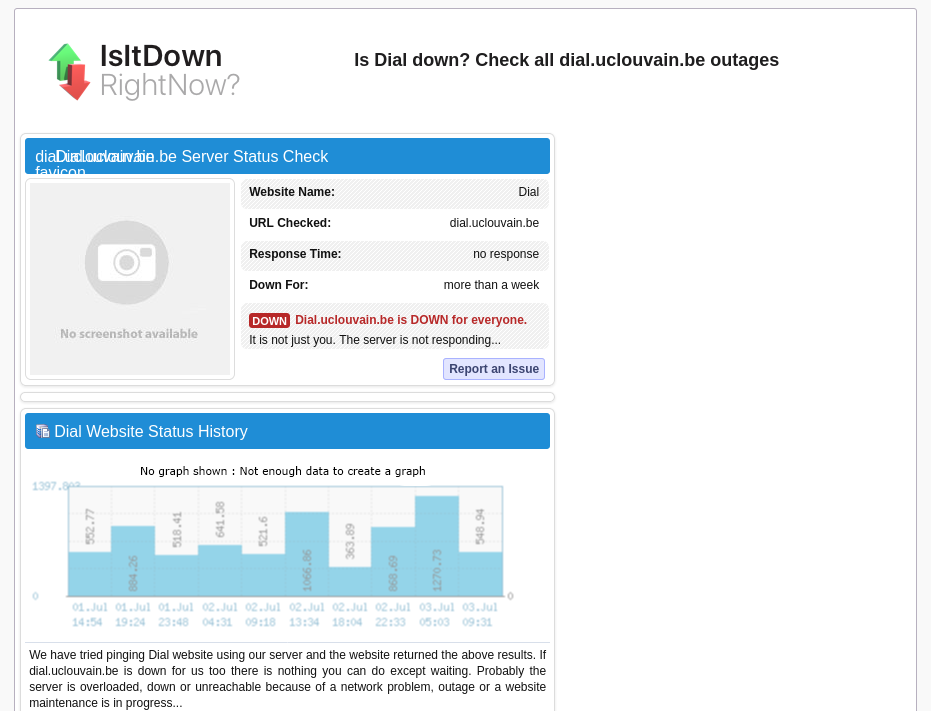
$ curl https://dial.uclouvain.be/pr/boreal/object/boreal:257256
curl: (28) Failed to connect to dial.uclouvain.be port 443 after 135797 ms: Could not connect to server
Thank you for considering our research papers. Supporting this scientific work is indeed essential to ensure the long-term sustainability of the Orthanc project.
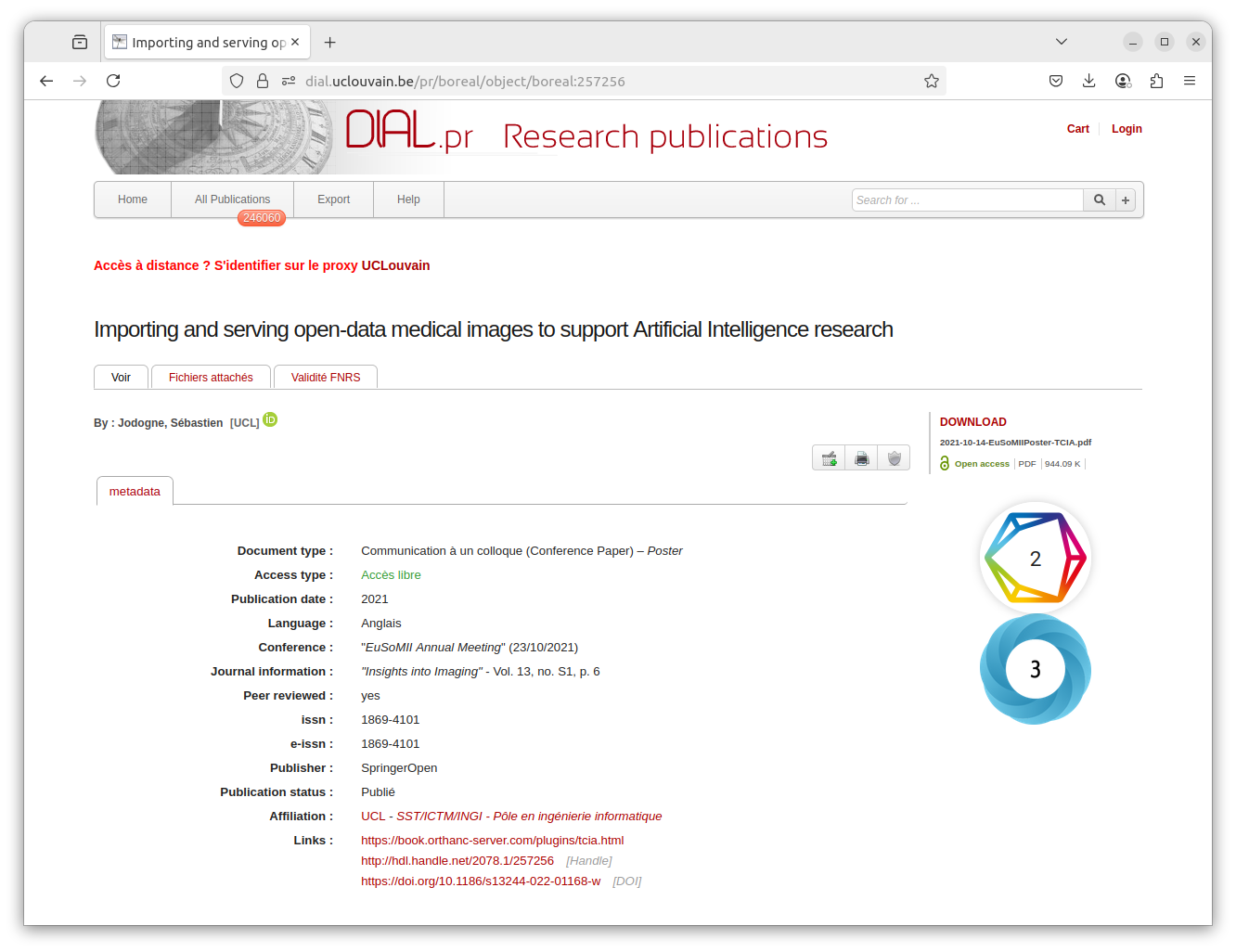
I can confirm that everything is working fine on our side. Here is a screenshot:
This probably reflects some badly configured firewall. There is unfortunately nothing I can personally do, as this is an institutional Web site. That being said, here is the proper BibTeX citation:
@inproceedings{boreal:257256,
 title = {Importing and serving open-data medical images to support Artificial Intelligence research},
 author = {Jodogne, Sébastien},
 booktitle = {EuSoMII Annual Meeting},
 journal = {Insights into Imaging},
 volume = {13},
 number = {S1},
 issn = {1869-4101},
 doi = {10.1186/s13244-022-01168-w},
 publisher = {SpringerOpen},
 year = {2021},
 url = {http://hdl.handle.net/2078.1/257256}}
Thanks! I was able to access the website using ProtonVPN to get an IP address from the Netherlands. You should ask UCLouvain to check on why their firewall is blocking website access from the United States.
I have received a response from the technical team of our institutional repository of scientific papers (named DIAL).
In a nutshell: Due to a high volume of requests from AI language models overloading the DIAL server, access from outside the EU has been temporarily restricted. The IT team is working on a solution to distinguish legitimate (human) traffic from illegitimate traffic, which may be slowed or blocked. A more sustainable fix is expected in the coming weeks. Sorry for the inconvenience.
Hi there, I’m with the TCIA team and would love to chat with anyone involved in maintaining this plugin. We’re in the process of making some big changes which will result in deprecating the NBIA software that currently holds our DICOM over the next year or so. We’ll be leveraging some other NCI systems in its place. We are interested to help prominent projects such as this one make a smooth transition.
The main place I would suggest focusing your attention for now is on leveraging the Imaging Data Commons (Getting started | IDC User Guide) as the new way to access our public DICOM data in your next release. https://discourse.canceridc.dev/ is available to ask any questions you have about the approach for doing this, or I’d be happy to arrange a short t-con if you want to discuss.
As far as I am concerned, I was wondering whether it would be possible to extend the DICOMweb servers of IDC to enable filtering of DICOM studies according to the The Cancer Imaging Archive (TCIA) collections to which they belong. This morning, I attempted to issue a QIDO-RS query at the Study level using the Study ID (0020,0010) tag (assuming it would contain the identifier of the parent collection), but received the following response:
$ curl 'https://proxy.imaging.datacommons.cancer.gov/current/viewer-only-no-downloads-see-tinyurl-dot-com-slash-3j3d9jyp/dicomWeb/studies?00200010=PBCFZC&&limit=101'
[{
  "error": {
    "code": 400,
    "message": "StudyID is not a supported study level attribute",
    "status": "INVALID_ARGUMENT"
  }
}
]
The nice stuff with the NBIA software is indeed that it is possible to browse the image collections, which doesn’t seem to be possible right now using DICOMweb. But maybe I missed something?